ALONG A LINE
The cycloid
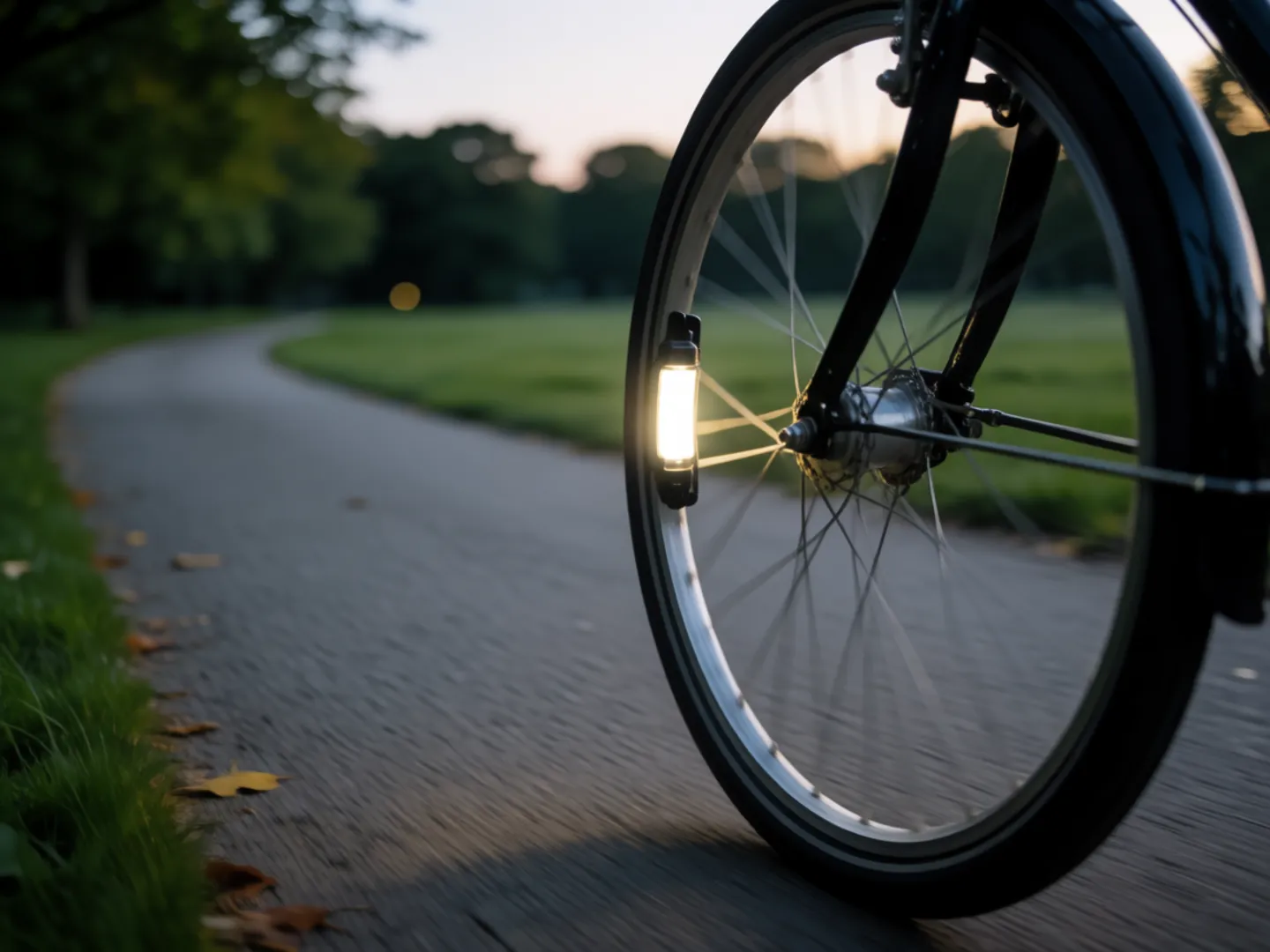
A point on the rim of a wheel rolling along a straight line traces a cycloid. The length of its base equals the circumference of the rolling circle.
See its numbers gyrodoodle
Start
THE MATHS OF ROLLING CIRCLES
Roll a circle along a line or around another circle, and a point on it draws a curve.
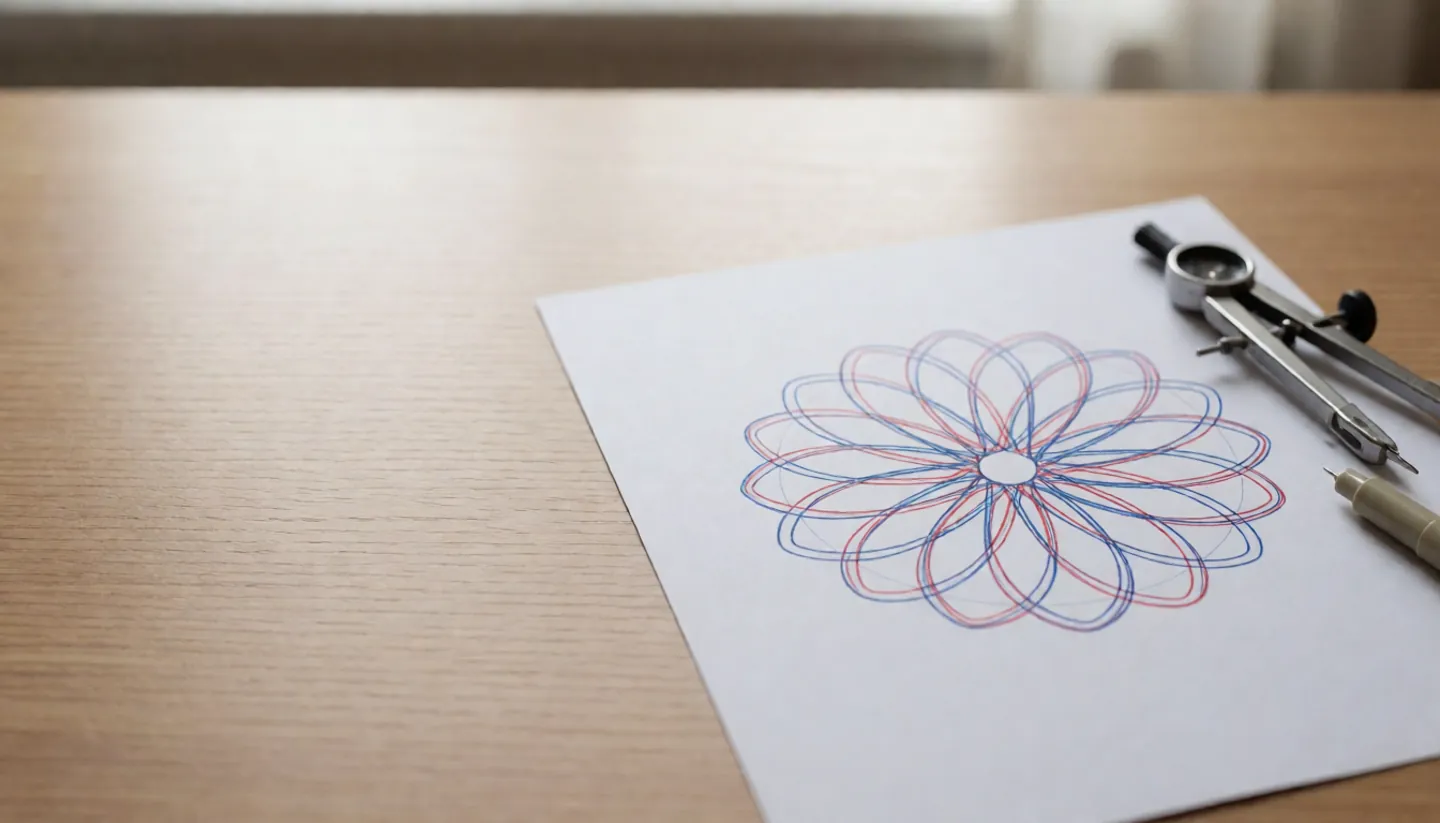
Those curves have names, histories and some surprising properties, and mathematicians from Dürer to Euler studied them. This is an independent guide drawn from the MacTutor History of Mathematics archive at the University of St Andrews.
1599Galileo names the cycloid
Pick a ratioKeep in mind
THE SHORT ANSWER
Roll along a line: a cycloid.
Roll around a circle: an epicycloid or hypocycloid.
ALONG A LINE
A point on the rim of a wheel rolling along a straight line traces a cycloid. The length of its base equals the circumference of the rolling circle.
See its numbersAROUND A CIRCLE
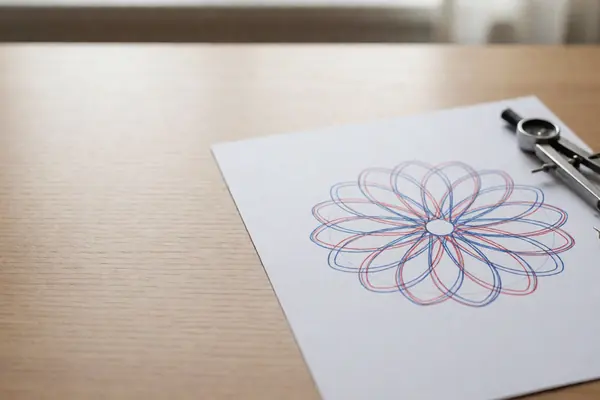
Roll a circle round the outside of a fixed circle for an epicycloid, or round the inside for a hypocycloid. Move the point off the rim for the looping trochoids.
Pick a ratioIN THE LIGHT
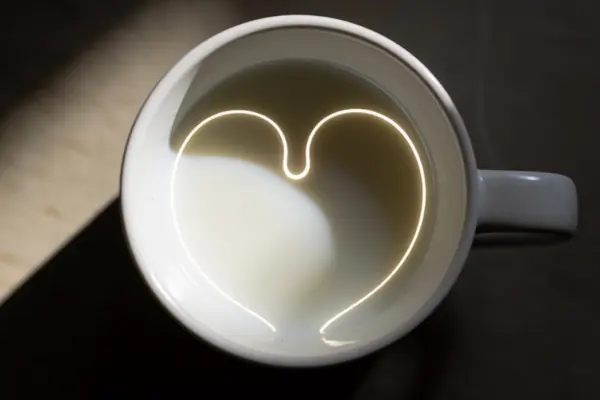
Light from far away reflected inside a circle forms a nephroid, the two-pointed epicycloid. Huygens showed this in 1678.
More historyA QUICK RATIO CHECK
Pick a pair of circles. The fixed circle stays still and the smaller one rolls, with the tracing point on its rim. The bar shows how many sharp points (cusps) the curve gets.
Sizes compare the fixed circle with the rolling one. With the point inside the rim instead, the curve becomes a trochoid with rounded loops.
TWO NUMBERS WORTH KNOWING
Both figures are for one arch of a cycloid,
traced by a point on the rim of a wheel.
3× the wheel
Area under one arch
Galileo weighed metal cut-outs and found a ratio of about 3 to 1, but wrongly guessed it was not exact. Roberval showed the area is 3πa², three times the area of the rolling circle.
ROBERVAL, 1634
8× the radius
Length of one arch
Responding to Pascal's 1658 challenge, Christopher Wren found the arch is 8a long, where a is the radius of the rolling circle.
WREN, 1658
Source: MacTutor History of Mathematics, Cycloid entry. Here a is the radius of the rolling circle, with the tracing point on its rim.
FOUR CHOICES TO MAKE
Every one of these curves comes from the same few choices. Change one and the shape changes.

Step 1
Roll along a straight line for a cycloid, or around a fixed circle for the epicycloid and hypocycloid family.
Step 2
Rolling round the outside gives an epicycloid; rolling round the inside gives a hypocycloid.
Step 3
On the rim you get sharp points called cusps. At another distance from the centre you get a trochoid, such as a hypotrochoid.
Step 4
The sizes of the two circles set the pattern: equal circles give a one-pointed cardioid, a quarter-size circle inside gives a four-pointed astroid.
A CURVE THAT KEPT TIME
Mersenne, Descartes, Fermat, Torricelli, Pascal and Wren all worked on the cycloid. Huygens found in 1673 that a particle sliding on a cycloid takes the same time to reach the bottom wherever it starts, and built a pendulum clock to swing in a cycloid arc, though it proved impractical. In 1697 Johann Bernoulli published his solution showing the cycloid is also the curve of fastest descent.
The rolling-circle family had admirers for centuries. MacTutor lists Dürer studying these curves in 1525, followed by Desargues, Huygens, Leibniz, Newton, the Bernoullis and Euler. Desargues even proposed cycloid-shaped teeth for gear wheels in the 1630s.
Questions
The curve traced by a point on a circle as the circle rolls along a straight line. With the point on the rim, the length of one arch's base equals the rolling circle's circumference.
In an epicycloid the moving circle rolls round the outside of a fixed circle; in a hypocycloid it rolls round the inside. In both, the tracing point is on the moving circle's rim.
The same as a hypocycloid, except the tracing point is at some distance from the centre of the rolling circle rather than on its rim, which gives rounded loops.
The name means heart-shaped. De Castillon first used it in 1741 in a paper in the Philosophical Transactions of the Royal Society.
Galileo, in 1599. In 1639 he wrote to Torricelli that he had been studying its properties for 40 years.
Two of them are caustics, the curves that light forms after reflecting inside a circle. MacTutor says Huygens showed in 1678 that light from a source at infinity gives a nephroid, while light coming from a point on the circle's circumference gives a cardioid, as Jacob and Johann Bernoulli showed in 1692. Explaining the nephroid needed the wave theory of light: Airy produced the proof in 1838.
Yes. As well as rolling a circle of radius a/4 inside a circle of radius a, MacTutor notes that an astroid is the envelope produced when a line segment moves with one end on each of two perpendicular axes, which makes it a glissette. It has also been called the tetracuspid, cubocycloid and paracycle.
Destination
Updated
ABOUT THIS NAME
gyrodoodle.com is part of the DoodleSale portfolio. It isn't in an auction right now, but you can ask about leasing it.